Environment & Ecology | GS III
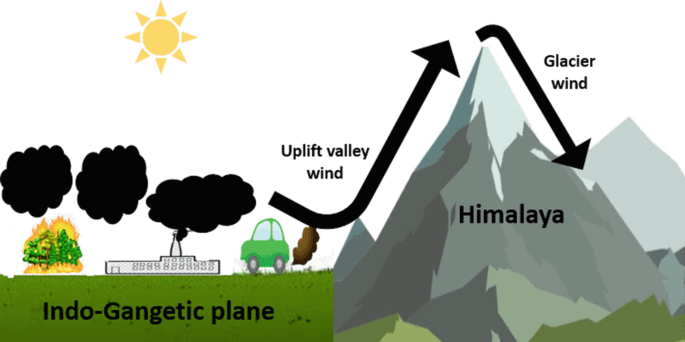
A study by the Aryabhatta Research Institute of Observational Sciences (ARIES) found rising concentrations of Non-Methane Hydrocarbons (NMHCs) in Munsyari (Uttarakhand), indicating that even remote Himalayan regions are increasingly affected by anthropogenic air pollution.
What are Non-Methane Hydrocarbons (NMHCs)?
- NMHCs are volatile organic compounds (VOCs) excluding methane that are released from:
- Importance: NMHCs are highly reactive in the atmosphere and contribute to the formation of:
- Impact on air quality: NMHCs react with Nitrogen Oxides (NOx) and Sunlight to produce Tropospheric ozone + Secondary particulate matter.
Why are Himalayan ecosystems particularly vulnerable?
- Mountain ecosystems:
- Pollutants can persist longer in valleys and affect both ecosystems and local communities.
Why is pollution increasing in the Himalayas?
Structural Factors
- Growing tourism footprint: Increasing tourist arrivals, higher vehicle movement, and expansion of hospitality infrastructure.
- Rising energy consumption: LPG use, diesel generators, and transport fuel consumption have increased local emissions.
- Construction-led ecological pressure: Road expansion, tourism infrastructure, and urbanisation of mountain settlements contribute to pollutant emissions.
- Long-range transport of pollutants: Pollutants from the Indo-Gangetic Plain and Urban centres can be transported to Himalayan regions through atmospheric circulation, valley winds, and long-range air transport processes.
Cyclical Factors
- Seasonal meteorological variations: Higher NMHC concentrations observed during spring and autumn due to favourable atmospheric conditions.
- Role of Aromatic Hydrocarbons: Compounds such as Benzene and Xylene were found to significantly contribute to:
Conclusion:
The Himalayas can no longer be viewed as naturally protected from air pollution. Safeguarding these fragile ecosystems will require balancing tourism, development, and environmental protection through sustained monitoring and region-specific air quality governance.
________________________________________________________________________________________________
News to MCQs
Consider the following statements regarding Non-Methane Hydrocarbons (NMHCs):
1) NMHCs contribute to the formation of tropospheric ozone.
2) NMHCs are important precursors of secondary organic aerosols.
3) Methane is classified as a Non-Methane Hydrocarbon.
Which of the statements given above are correct?
(a) 1 and 2 only
(b) 2 and 3 only
(c) 1 and 3 only
(d) 1, 2 and 3
Answer: A
Explanation:
NMHCs are reactive volatile organic compounds excluding methane. They play a major role in the formation of ground-level ozone and secondary organic aerosols through atmospheric chemical reactions. These secondary pollutants affect air quality, climate, and human health. Since methane is specifically excluded from the NMHC category, Statement 3 is incorrect.
Therefore, only Statements 1 and 2 are correct.